2021
VEX IQ World Championships
Competed at the VEX IQ World Championships with team 7700J.
I build across technology, AI, healthcare and marketplaces. Founder & CEO of OfficeSwap. Co-Founder of MirRehab.

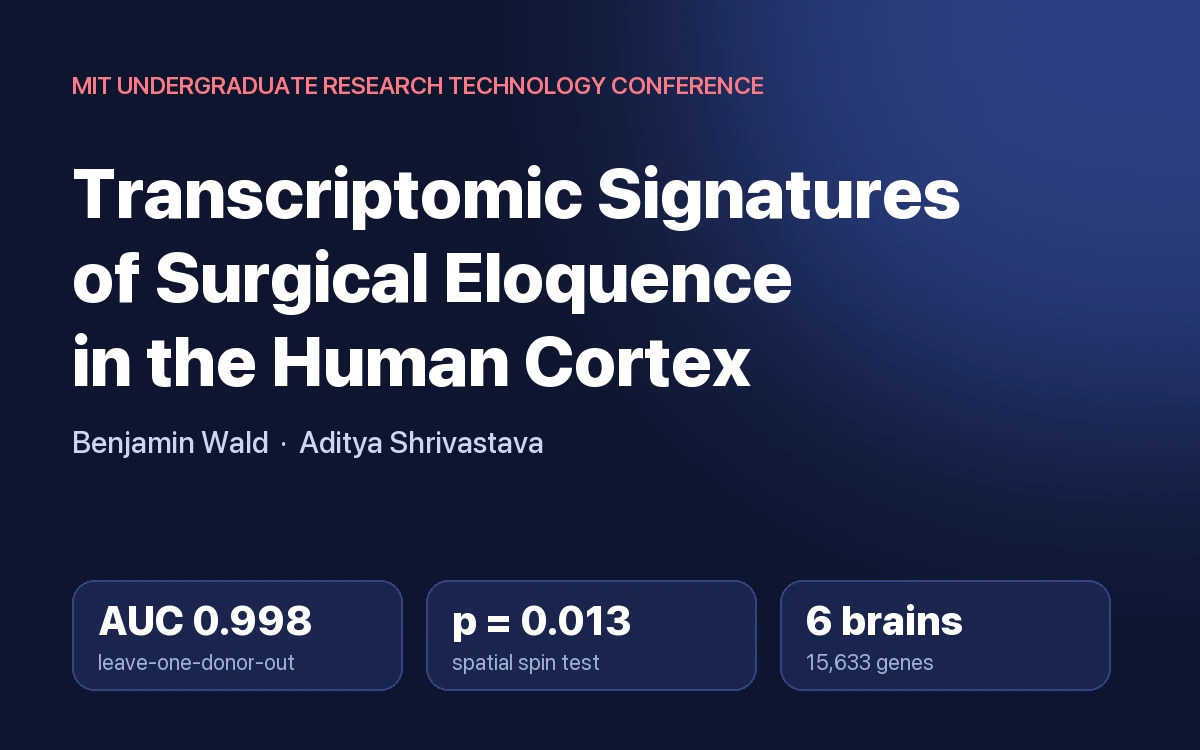
Surgeons must avoid cutting “eloquent” cortex, the regions that control movement, sensation, sight, hearing and language, yet it is defined by function, not by molecules. This paper asks whether eloquent cortex has a molecular signature in baseline gene expression, and whether that signature survives once the smooth way expression varies across the cortex is accounted for. A classifier trained on Allen Human Brain Atlas data separated eloquent from silent cortex in held-out brains. The result held against a spatial spin test and under an independent labeling, and the top genes pointed to a fast-firing, parvalbumin-interneuron-rich program in eloquent cortex.
Computational neuroscienceAllen Human Brain AtlasGene expressionSurgical eloquenceSpin testMachine learningGlioma surgeryParvalbumin interneurons
Neurosurgically eloquent cortex, which a surgeon must preserve to avoid inducing an enduring functional deficit, is defined by function rather than molecular composition. This study investigates whether a unique baseline transcriptomic signature exists for these regions and whether such a signature persists after accounting for significant spatial autocorrelation in gene expression across the cortex. Leave-one-donor-out classifiers were trained on microarray data from six human brains (15,633 genes) from the Allen Human Brain Atlas, aggregated to the Desikan-Killiany parcellation. The results reveal a significant ability of molecular signals to discriminate eloquent cortex from silent cortex (AUC 0.998 ± 0.004 for logistic regression, under a biologically curated labeling). A spatial spin test of this effect, following the Alexander-Bloch methodology, reached statistical significance under 1000 simulations (p=0.013). Under an independently generated, Yeo 2011 seven-network-based labeling of the cortex, the ability to discriminate continued (AUC 0.926, p=0.007 under a more stringent null), reaching significance at p<0.01 under 1000 iterations.
Furthermore, Gene Ontology enrichment on the top-predicting genes recovered a “fast-firing, parvalbumin-interneuron-rich program” (Potassium Ion Transport, GO:0006813; PVALB-marker clusters) enriched within eloquent cortex and an astrocyte-enriched program within silent cortex. Although removing the main transcriptomic gradient from the data caused the hand-curated effect to collapse back to the spatial null, a significant result persisted for the independent Yeo labeling (p=0.026, logistic regression). This finding suggests that the eloquent portion of the brain contains a molecular signature, at least partially and by no coincidence under a functionally derived labeling, that is independent from the cortex-wide expression gradient.
Competed at the VEX IQ World Championships with team 7700J.
Competed at the VEX IQ World Championships again with team 7700J.
Competed at the VEX IQ World Championships for a third year in a row with team 7700J.
Admitted to the MIT Undergraduate Research Technology Conference (URTC) for my research paper on surgical eloquence in the human cortex, with Aditya Shrivastava.
 OfficeSwapFounder profileofficeswap.co/benjamin-wald↗
 MirRehabFounder profilemirrehab.com/team/benjamin-wald↗
Find me on LinkedIn, or take a look at what I'm building at OfficeSwap and MirRehab.